3D ARPG Roguelite
Tools: Unreal Engine 5, Perforce, Notion


Duration: 11 January 2026 –
Team Size: ~16
Introduction
“Create powerful spell combos and blast through hordes of enemies in RealmWalker. This ARPG roguelite delivers ever changing runs with new abilities, challenging encounters, and procedurally generated worlds.” – From steam.
I found a posting online for a project looking for programmers. The game looked interesting so I reached out to see if they had any need for designers as well. I got a response that they did and I was brought on to the project.
My primary work on the project was with the third and final level of the game, which I was the main designer of, though I did work on the first and second level as well.
Workflow
From the start, I took ownership of Level 3, focusing on blockout, pacing, and core gameplay beats in a more isolated workflow. As development progressed, I started to sync more closely with design, art, and systems, ensuring consistency in player experience and difficulty curves. This shift allowed me to iterate more effectively, integrate with the rest of the team, and refine the level to better support the game’s overall progression and readability.
I made some rooms for level 1 and 2 on top of level 3. This is an example of my workflow when making a room for level 1.

This was the second room I made for Level 1 and I wanted to really focus on vertical movement and combat as it was something I felt was missing from the first level. The original ideas was for a room with two levels where you could go up and down while still having it be open enough to allow for tracking and attacking enemies from both heights.


After drawing the topdown I made a quick blockout to get a feeling for scale and where to really place stairs. The walkway that went across all the way made fighting too simple, so I immediately added a hole to it and moved the stairs to the central platform to ensure the player would have to engage with enemies there.


After receiving some playtesting I realized that having just one point where you could get up was too difficult and I added a broken part of the corner to allow going up elsewhere. This also gave more reason to be by the ends of the room.


The room has not yet received its final pass but I still feel it is a good example of the workflow on the project.
Design intent
Some design goals I had for the third level were:
- Make rooms flow from one to another naturally (Not obvious transitions)
- Support and incentivize movement in and out of battle.
- Make the level unique from the existing levels while still feeling anchored to them
Level Design
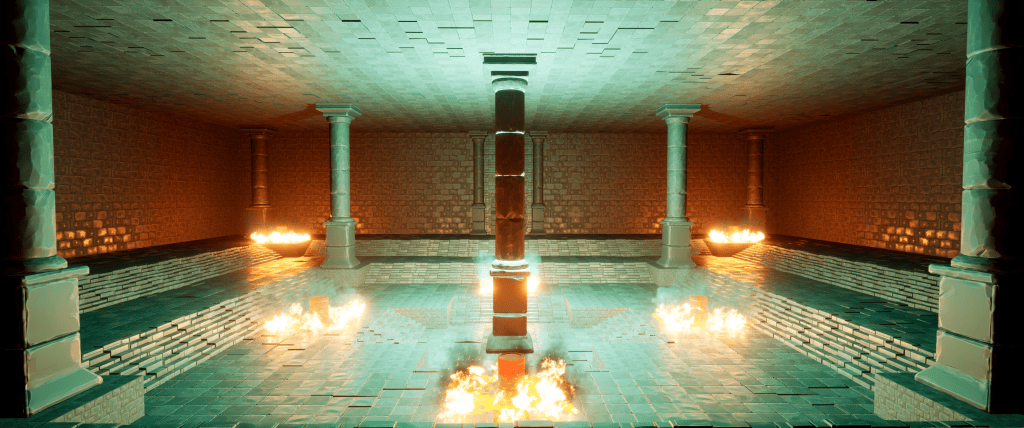
RealmWalker has three levels including the final one, which I made. The first is primarily made up of enclosed rooms and corridors with the occasional big arena.


The second is an ice level with more natural and rounded shapes as well as a step up in difficulty.


For the third level I wanted to do something that felt unique while still keeping a clear through line from the previous two levels.

Flow: The primary intent with this was to create a seamless hop between two different rooms. Most of this is simply aligning all the possible exit combinations, both in position as well as shape. The reason this was such an important part of the design was partially to support and ground the kind of rooms I wanted to make, and partially just because I find it detracts from the experience in games with procedural levels when you notice the system at work.
During development I had issues with different room’s lava not aligning.

This was because of different rooms having lava at different heights relative to the entrance point which is the anchor that rooms connect with. I considered always having lava be at a set height relative to the entrance in a room and designing around that, even if that would require all entrances and exits in a room be at the same height as well. Another idea was to dynamically shift all lava at runtime to fit together. This would however be way more complex and would be difficult to build around since the lava would change unpredictably.
The most effective solution and the one I ultimately decided to go with after some discussion was to let lava be at different heights and make it look natural by having each room be a floating island connected by paths and platforms. This serves the goal of having an open level and breaks the visuals up more naturally.

It also helped with handling enemies from previous rooms as you progress through the level more cleanly as we could just drop away earlier islands.
Movement: I wanted to incentivize not just moving away from the nearest enemy, but using the environment as another part of the combat and core experience. This one was learned from experience. For a previous project I did which is not on my portfolio, I did the rooms and parts of the implementation of a similar game and in it at the end I noticed that movement was not particularly incentivized outside of just moving from room to room, not really engaging with the environment.
Some examples of this are:
- The Lava itself is probably the biggest part as it serves multiple purposes across rooms. In some it’s a sea underneath, giving you plenty of air room above while punishing anyone who falls in, in others it’s rivers cutting across, forcing you to maneuver around it and in one room it even rises, forcing you to run.
- Loot in the form of vases and chests with items that help in the run as well as between runs are scattered across the rooms. Some of these are slightly hidden or hard to reach and require you to explore just a little.
Unique: Both the previous levels were relatively enclosed, especially the first one. For the third one I wanted to open things up. My ambitious original idea was to have all the room laid out on one large ocean of lava which you could freely see and move across, with the damage of the lava being the thing keeping you somewhat on track. While this would be cool, it did not work with all the movement spells letting you easily bypass rooms, so I had to change it slightly.
The rooms themselves are still very open (with a few exceptions) and allow for plenty of movement but they are not laid out across a vast ocean but instead as floating islands. This helps differentiate it from earlier levels. It also helps visually smooth over any height differences between rooms and allows for freer movement within rooms and between them while still not being on a flat plane, which would make skipping rooms too easy.
Conclusion
Once the game is released, I will get back to my conclusions.